
The Morgue / The Drills Stopped
The Drills Stopped
The fifties gave children a procedure. The eighties gave them a mushroom cloud over the neighborhood and nothing whatsoever to do about it.
Nobody got under a desk in 1983
Here is the thing that gets missed in every retrospective, because the archive footage is all from the wrong decade.
By the time American nuclear fear reached its genuine peak — 1982, 1983, 1984 — the school drills were over. There was no crouching in the corridor. There was no siren on a Tuesday. Kids who were nine years old in 1981 mostly remember the subject arriving through current events discussion in social studies, and otherwise not arriving at all.
The fear did not go away when the drills did. It went up. What changed was that it lost its procedure.
Bert the Turtle had a procedure
In 1951 the newly created Federal Civil Defense Administration commissioned a nine-minute film from a small New York outfit called Archer Productions. It cost very little and it starred an animated turtle who pulls into his shell when a monkey dangles a firecracker at him. It was shown in American schools for years, and its instruction was in the title: duck, and cover.
Alongside it came the apparatus. Drills where children knelt under desks with their hands laced behind their necks. Fallout shelter signs — that yellow and black trefoil on a metal plate — bolted to basements of libraries and municipal buildings from 1961 onward. Shelter stocks of biscuits and water drums. In New York, schoolchildren were issued identification tags to wear around their necks, and the reason for the tags is not one anybody said out loud to the children wearing them.
It is easy now to be superior about the desk. The desk did not stop a thermonuclear weapon and the people who designed the programme were perfectly aware of that. But the desk was never really the point.
The point was that there was something to do. An adult stood at the front of the room and said: here is the procedure, we have practised it, follow me. Civil defence in the fifties was as much a morale instrument as a survival one — a country telling itself that this was a manageable problem with steps, like a fire or a tornado. Whatever else that is, it is a form of care. Somebody was in charge.
Why they quit
Two things ended it.
The first was arithmetic. The weapons of 1952 were not the weapons of 1972. Yields went up by orders of magnitude, and delivery moved from bombers that might take hours to intercontinental missiles that took about half an hour, and then to single missiles carrying many independently targeted warheads. There is no posture you can adopt in a corridor that engages meaningfully with that, and by the seventies the pretence had become embarrassing to maintain.
The second was politics. Détente lowered the temperature, arms limitation talks made the subject feel like something being handled by adults somewhere else, and civil defence budgets and enthusiasm both drained away.
So the drills stopped. Quietly, district by district, without an announcement — and nothing took their place.
What the second Cold War handed a nine-year-old
Then the temperature went back up, hard and fast, and it went up into a school system that had thrown away its script.
The early eighties were not a quiet stretch that people misremember as frightening. They were genuinely the most dangerous years since 1962. A major American defence buildup and a matching Soviet one. Pershing II and cruise missiles going into Western Europe against enormous public protest. A Soviet interceptor destroying a Korean airliner with 269 people aboard in September 1983. A NATO command exercise that November, Able Archer, which parts of the Soviet leadership appear to have seriously considered might be cover for a real first strike — a fact that only became clear from declassified material long afterward.
The reaction was proportionate and it was everywhere except in the curriculum. A nuclear freeze rally in Central Park in June 1982 drew something like a million people, the largest political demonstration in American history to that point. In December 1983 a team of scientists published the nuclear winter paper, which argued that even a limited exchange could darken and freeze the planet's agriculture — meaning that for the first time the people on the other side of the world were included in the casualty figures.
And a child in that decade received all of it with no procedure attached. No drill, no shelter, no adult with a clipboard saying here is what we do. Just the thing, hanging over the neighbourhood, discussed on the news at six and then not discussed at dinner.
A drill is patronising and mostly useless and it is also a promise that somebody is minding it. Take the drill away without taking away the danger, and what remains is pure ambient dread with nowhere to put itself. That is a worse object to hand a nine-year-old than a desk.
One hundred million people watched a bad movie
On the twentieth of November 1983, ABC broadcast a two-hour television film about Lawrence, Kansas being destroyed in a nuclear exchange.
Roughly a hundred million Americans watched it. Nearly thirty-nine million households — around two-thirds of everyone watching television in the country that night, on a Sunday, against sitcoms and a Kennedy miniseries. It stood as the most-watched television movie ever made for the next twenty-six years.
The details around the broadcast say more than the film does. ABC ran the final hour with no commercial breaks at all, in part because advertisers would not touch it. An actor appeared onscreen beforehand to warn parents to take small children out of the room and be ready for questions from the older ones. Viewer guides went out to schools in advance. Immediately afterward, the network put Ted Koppel on air with a panel including Henry Kissinger, Carl Sagan and Robert McNamara, and Koppel opened by telling the audience to look out the window and confirm that everything was still there.
Nobody sets up a suicide hotline and a panel of statesmen for a movie. They set it up for an event.
And the film itself is not very good. It was cut down from a much longer version and it shows; the characters are thin and the pacing is strange. That was beside the point then and it is beside the point now. It was not competing on quality. It was the only permitted glimpse — one night when the thing everybody had been carrying around unspoken was allowed onto the screen in the living room, and the entire country looked at it simultaneously.
What people kept afterward was rarely the blast. It was small domestic details of the afterward. What you would trade. What would suddenly be worth something. Ordinary objects reassigned.
The president had already seen it
He watched a screening copy at Camp David on the tenth of October, six weeks early. His diary entry for that day records that the film was powerfully done and that it left him, in his own words, "greatly depressed" — and then, in the next line, that his conclusion was that America had to maintain a deterrent and ensure a nuclear war never happened.
Two days before the broadcast he sat through a full briefing on American nuclear war plans in the Situation Room and wrote that it was a sobering experience, noting that the sequence of events resembled the one in the movie.
Four years later he signed the Intermediate-Range Nuclear Forces Treaty, which eliminated an entire class of weapons. Afterward he sent the film's director a message: "Don't think your movie didn't have any part of this, because it did."
Whether a television film changed the course of arms control is not a question this article can settle, and serious people disagree about it. What is not in dispute is that in November 1983 the man with the authority to end the world and the nine-year-old with no drill to practise were both frightened by the same broadcast on the same night.
And then it became a setting
The strangest thing happened after the Cold War ended, and it is the reason a modern reader can find all of the above quaint.
The end of the world became a genre.
It has conventions now, and everyone knows them: the barter economy, the ammunition and batteries and antibiotics as currency, the road, the fortified settlement, the group that has decided the rules no longer apply. These are furniture. They arrive pre-installed in a video game, a streaming series, a young adult trilogy. You can enjoy them the way you enjoy a haunted house, which is to say with the certainty that you will walk out at the end.
That is not a complaint about the quality of any of it. It is a structural observation, and it cuts one way only. A fear you have made comfortable cannot loom. In 1983 a detail about what people would trade afterward was speculation about something that might genuinely happen the following year, and it lodged in a nine-year-old permanently. The same detail today is a setting.
Procedure, then specter, then trope. Only one of those three is frightening, and it is the one with nothing to do in it.
The man in the suit
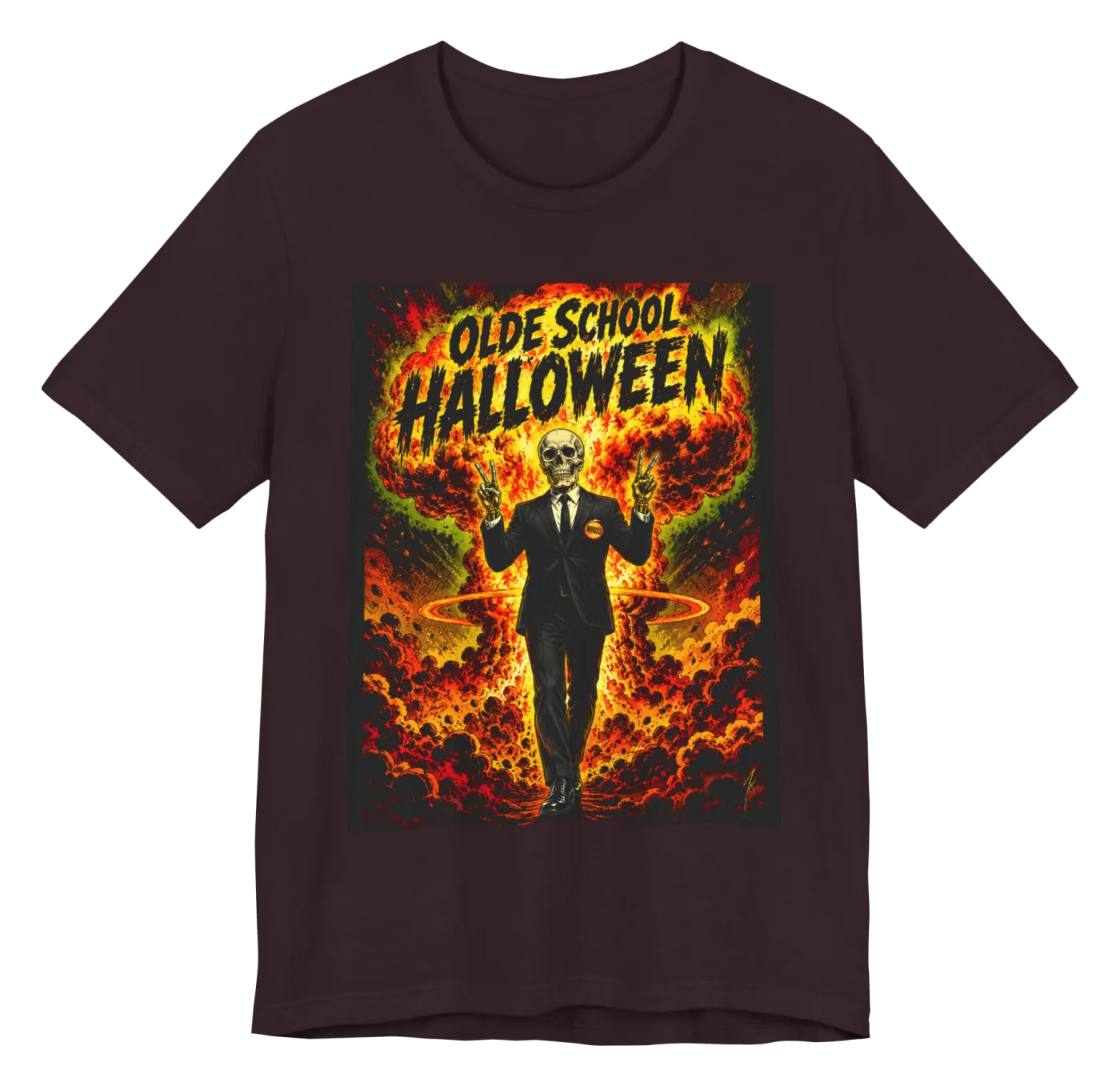
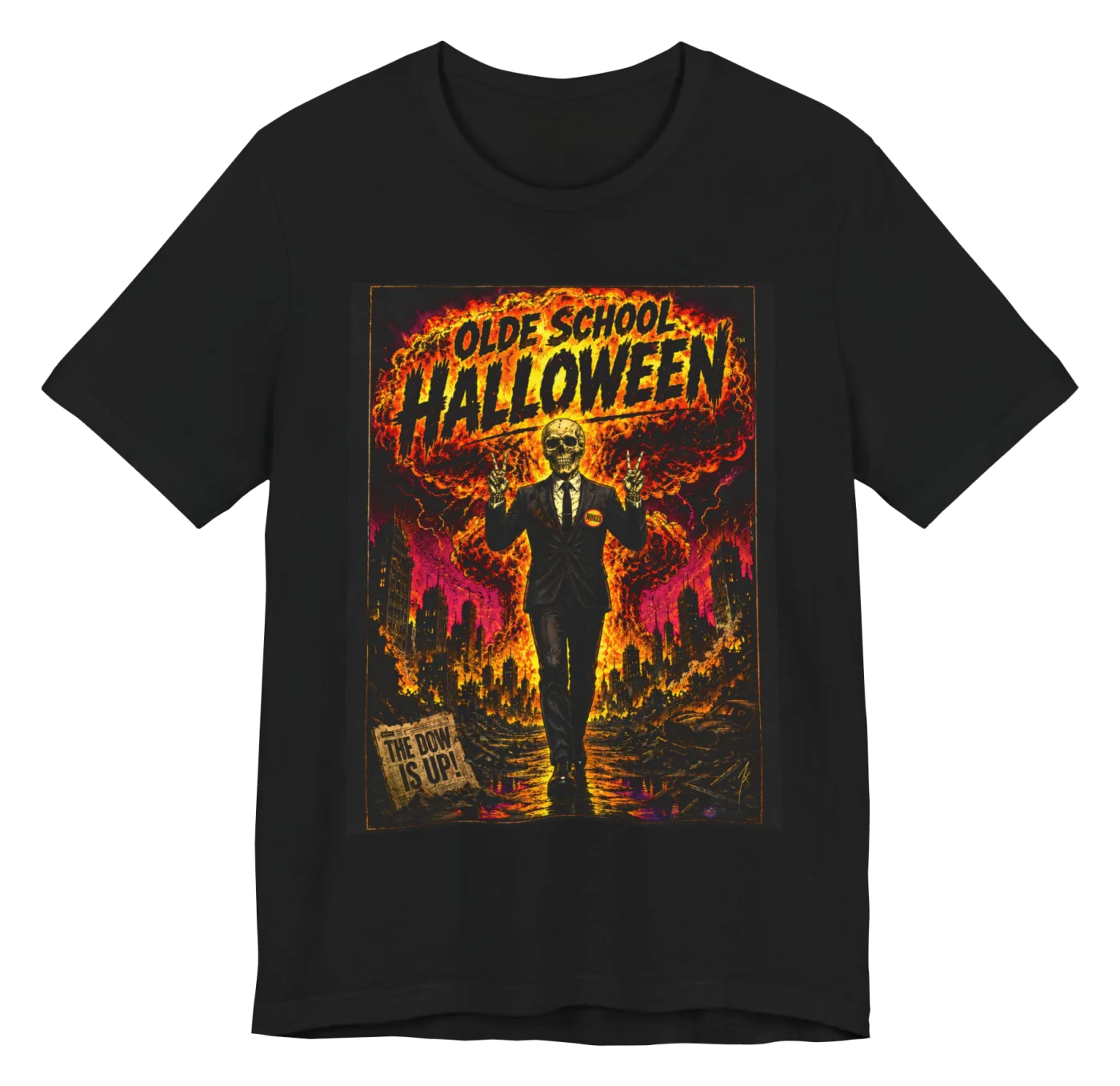
Which brings us to the figure on these shirts, and to what he is not.
He is not a fallout mascot and he is not an atomic-age gag. He is Death — the actual one, the ancient one, patient and impartial and entirely uninterested in your politics. The suit is the tell. He is not costumed as a monster; he is dressed for business, with a campaign button on the lapel, canvassing.
Look at where the trilogy goes. The first poster is abstract: the figure, the cloud, nothing else. The second puts him in a burning city with a newspaper face-up in the gutter reporting that the market has risen. The third walks him down a residential street past cooling towers and picket fences and a mailbox, and there are three children out trick-or-treating on the same pavement, in costume, with plastic pumpkins.
Nobody in that third picture is running. That is the whole eighties in one frame — the thing is above the neighbourhood, and the evening proceeds as normal, because there is no drill and no procedure and nothing to do but go get the candy.
And the cloud is behind him rather than around him for a specific reason. He was always going to arrive. He has been walking to every address on earth since the beginning, on foot, at his own pace. The bomb is just the first thing we ever built big enough that he doesn't have to.
Shirts from this one
Three from ground zero, suburbs included.

The Porchlight
New shirts. Olde stories. First word on every sale.
Twice a month, thereabouts. Unsubscribe whenever.