
The Morgue / The Man Who Read The Dictionary
The Man Who Read The Dictionary
Clark Ashton Smith left school after eight years, taught himself out of a dictionary and an encyclopedia, wrote a hundred stories in eight years, and then stopped for twenty-four.
Eight years of school
He was born in 1893 outside Auburn, California, gold country, and he went to grammar school in town and that was the end of his formal education. Eight years. No high school. There is a reason usually given — agoraphobia, a horror of crowds and enclosed rooms full of people — and whatever the cause, the schooling stopped and never resumed.
So he did it himself, in the way that only works if you have the particular equipment he had. He read Webster's Unabridged Dictionary straight through. Then the Encyclopaedia Britannica, cover to cover, twice. He taught himself French and Spanish and later translated Baudelaire out of the French for his own satisfaction. And he had a memory that gave nearly all of it back on demand — the kind of recall where a word read once at nineteen is still available at forty, with its etymology attached.
That sounds like a stunt. It is actually the whole explanation of his prose. Smith writes in a register nobody else in the pulps could reach because nobody else was carrying that vocabulary around. When he needs a word for a colour that has never existed, or a texture of decay, or the specific quality of light in a dying sun's last few million years, he has one, and it is the right one, and it is usually a word you have never seen before and will immediately understand.
The prodigy nobody remembers
Here is the part that surprises people: he was famous first as a poet, at nineteen, and briefly enormous.
At about eighteen he began writing to George Sterling, then the presiding literary figure of San Francisco. Sterling took him up, and in 1912 A.M. Robertson published The Star-Treader and Other Poems. The reviewers went off like a firework. A prodigy out of the Sierra foothills, Keats and Shelley invoked without embarrassment, all of it entirely genuine — some of the poems in that book had been written when he was fourteen.
He was grouped with the West Coast Romantics and called the Bard of Auburn and the Last of the Great Romantics, and Sterling, who had every reason to protect his own position, said outright that the pupil was going to eclipse the master.
Then the twentieth century happened to poetry. Formal, rhetorical, Swinburnean verse about the cosmos went out of fashion so completely and so fast that a career built on it in 1912 had nowhere to stand by 1925. He kept writing it. He published Ebony and Crystal himself in 1922 and went into debt doing it, and then spent three years working manual jobs to clear the printing bill.
The manual jobs, for the record, were these: fruit picking and packing, woodcutting, typing bills, journalism when he could get it, hard-rock mining, and later gardening. That is the working life of the finest fantasist America produced in the 1930s.
Then a letter from Providence
Ebony and Crystal did one thing that mattered enormously. Somebody showed it to H.P. Lovecraft, and Lovecraft wrote him a letter.
That was 1922, and it began fifteen years of correspondence that ran until Lovecraft's death. Lovecraft addressed him in letters as Klarkash-Ton, High-Priest of Tsathoggua, and meant every syllable of the compliment. It was Lovecraft, and the pulp market Lovecraft was working, that turned Smith from a stranded poet into a prose writer at all.
The prose came late and it came in a flood. From roughly 1929 to 1937 he wrote well over a hundred stories, nearly all of them for the pulps and most for Weird Tales, and he built four separate worlds to put them in.
Hyperborea, a continent going under the ice, where the toad-god Tsathoggua sits in his temple too indolent to rise for visitors, and two thieves walk into abandoned Commoriom expecting treasure and find a patient black viscidity in the altar basin instead.
Zothique, the last continent, under a dying red sun, where science has been forgotten and necromancy is a working profession — the founding text of the entire dying-earth subgenre, and everything from Vance to Gene Wolfe to half of modern fantasy's far-future settings traces back through it.
Averoigne, a medieval French province with real geography and unreal tenants, where the graveyards for forty miles empty in a single night and the dead walk in good order toward one ruined castle, because a very small sorcerer named Nathaire has decided to be stitched into a giant.
Xiccarph, and Mars besides — the vaults of Yoh-Vombis, where the archaeologists go down with lanterns and something flat and leathery lets go of the ceiling.
He did all that in eight years, at pulp rates, from a cabin with no electricity and no plumbing.
What he was actually doing it for
The obvious question is why a man who thought of himself as a poet spent a decade grinding out weird fiction for magazines that paid on publication and paid late.
His parents were dying, slowly, one after the other. Fanny and Timeus Smith were elderly and increasingly ill through the early thirties, and the household ran on whatever their son could bring in. From 1933 the fiction output starts breaking up because he was nursing. His mother died in 1935. He spent the next two years caring for his father, who died in December 1937.
That is the engine of the great period. Every one of those stories, every invented god and dying continent, was written by a man in a small cabin trying to keep two old people fed and doctored, selling to a market that paid a cent a word and often not on time.
And in the middle of it, everything else went too. Robert E. Howard shot himself in June 1936. Lovecraft died of cancer in March 1937 — on his desk was the manuscript of a poem addressed to Smith, in praise of his tales and verses and pictures and sculptures, apparently the last thing Lovecraft wrote that was not a letter. His father died nine months after that.
In something under two years, Smith lost both of the men he had been arguing and inventing with for a decade, and both of his parents.
He stopped.
Twenty-four years
Not dramatically, and not all at once, and he never announced it. The stories simply thinned out and then were not there.
He wrote some poetry. He answered letters. Writers made the trip up to Auburn to see him — Fritz Leiber came, and others — and found a courteous, quiet man in a cabin who did not particularly want to discuss the pulps.
Mostly he carved.
He had no training and no tools worth the name. He used soft local rock — talc, lava, whatever the Sierra foothills would give up — and he made small figures: gods, faces, things with too many features or not enough, the same population that had been walking through Hyperborea and Zothique, now in stone, four and five inches high. He made hundreds. He gave a lot of them away. Nobody had commissioned any of it and there was no market for it whatsoever.
August Derleth, who had founded Arkham House to keep Lovecraft in print, began collecting Smith's fiction into books from 1942. They sold slowly, went out of print, and became expensive rarities — which is its own quiet joke, that the work went from unsellable to unaffordable without passing through a period of simply being available.
He married in 1954, at sixty-one — Carol Jones Dorman, in Monterey — and moved to Pacific Grove with her and her three children. He had strokes. He wrote his last poem in June 1961 and died that August, sixty-eight years old.
The third man
There were three of them at the centre of Weird Tales and everyone knows two.
Lovecraft's adjective became a genre. Howard's barbarian became an industry. Smith is the one you find third — usually because Lovecraft mentions him, or because a footnote sends you to Tsathoggua — and then you read four pages and cannot work out how you got this far without him.
He is the one the other two thought was the best writer of the three. Lovecraft said so repeatedly and without qualification.
Part of the reason he is third is that he does not offer what they offer. Lovecraft gives you dread — the universe is vast and indifferent and you are nothing. Howard gives you defiance — the universe is savage and you swing at it anyway. Smith gives you neither. Smith's characters come to bad ends, usually ironic ones, usually earned, and the narrator is plainly enjoying it. There is no horror at the void in him. There is relish. A civilisation collapsing into ice, a sorcerer's ambition curdling, a thief eaten by furniture — these are described with the delight of a man laying out a good meal.
That is a harder thing to market than dread or defiance. It is also why the people who love him love him the way they do.
He read the dictionary because he intended to describe things nobody had described. He got eight years to do it in. Then he put it down and made small gods out of soft rock, by hand, in a shed, for nobody who had asked.
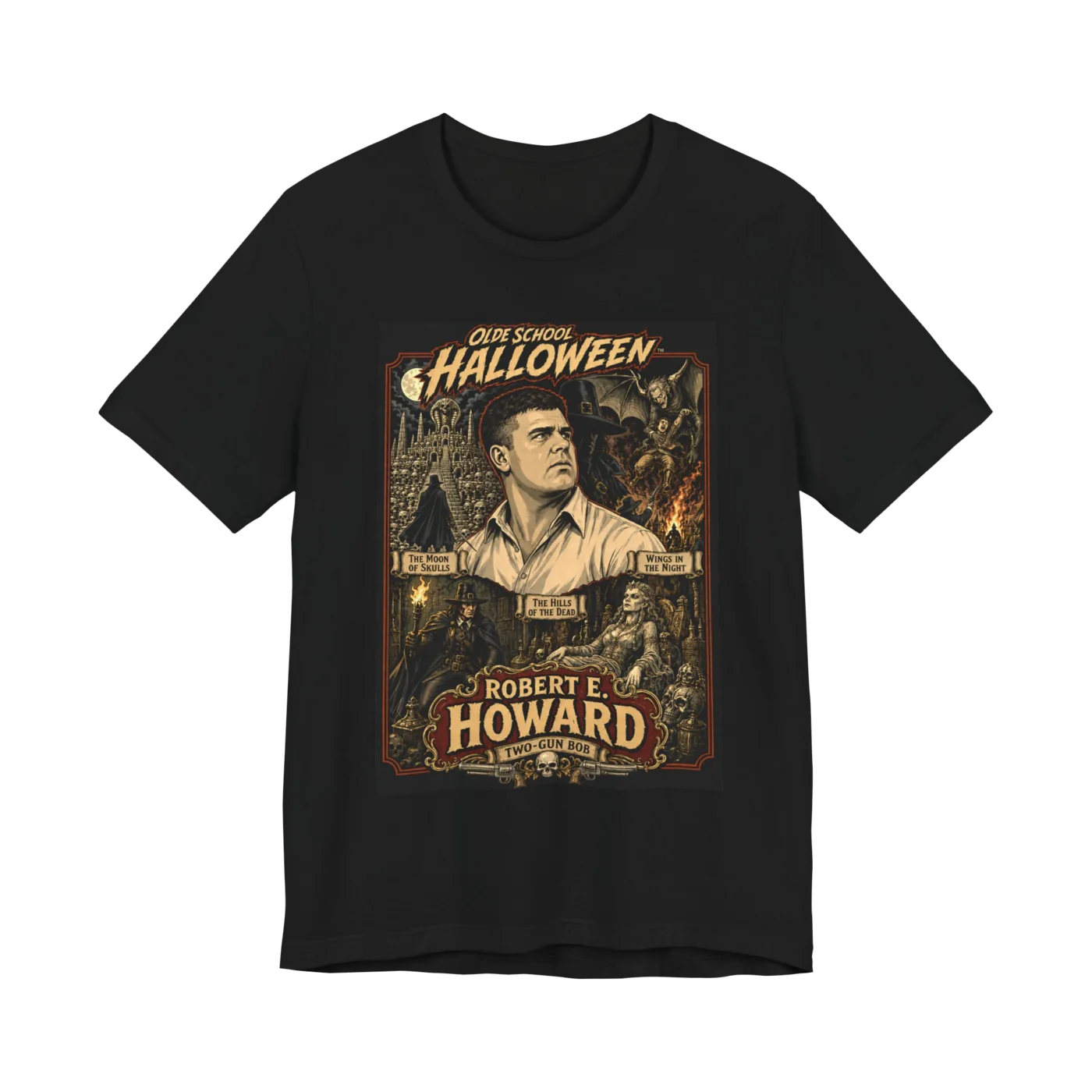
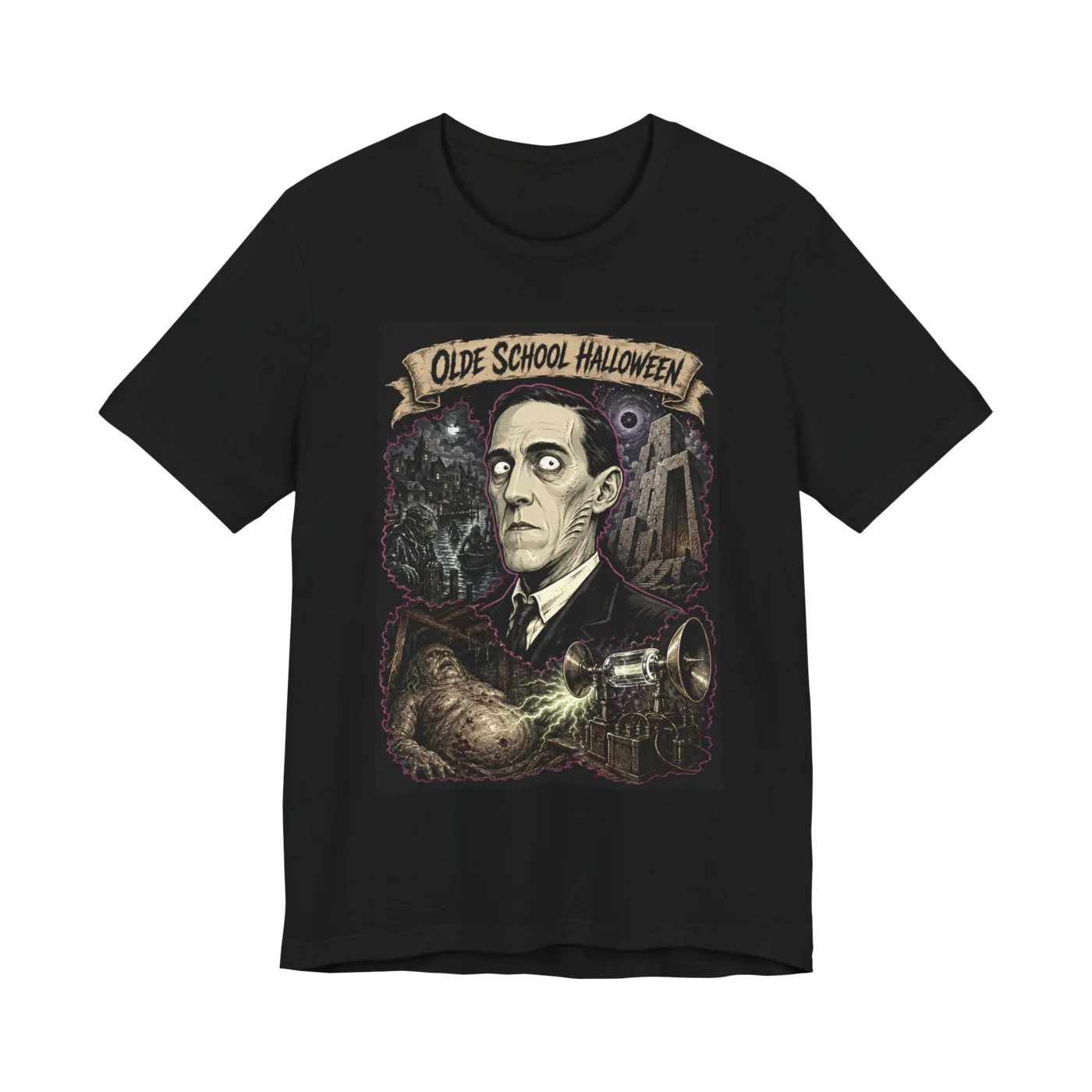
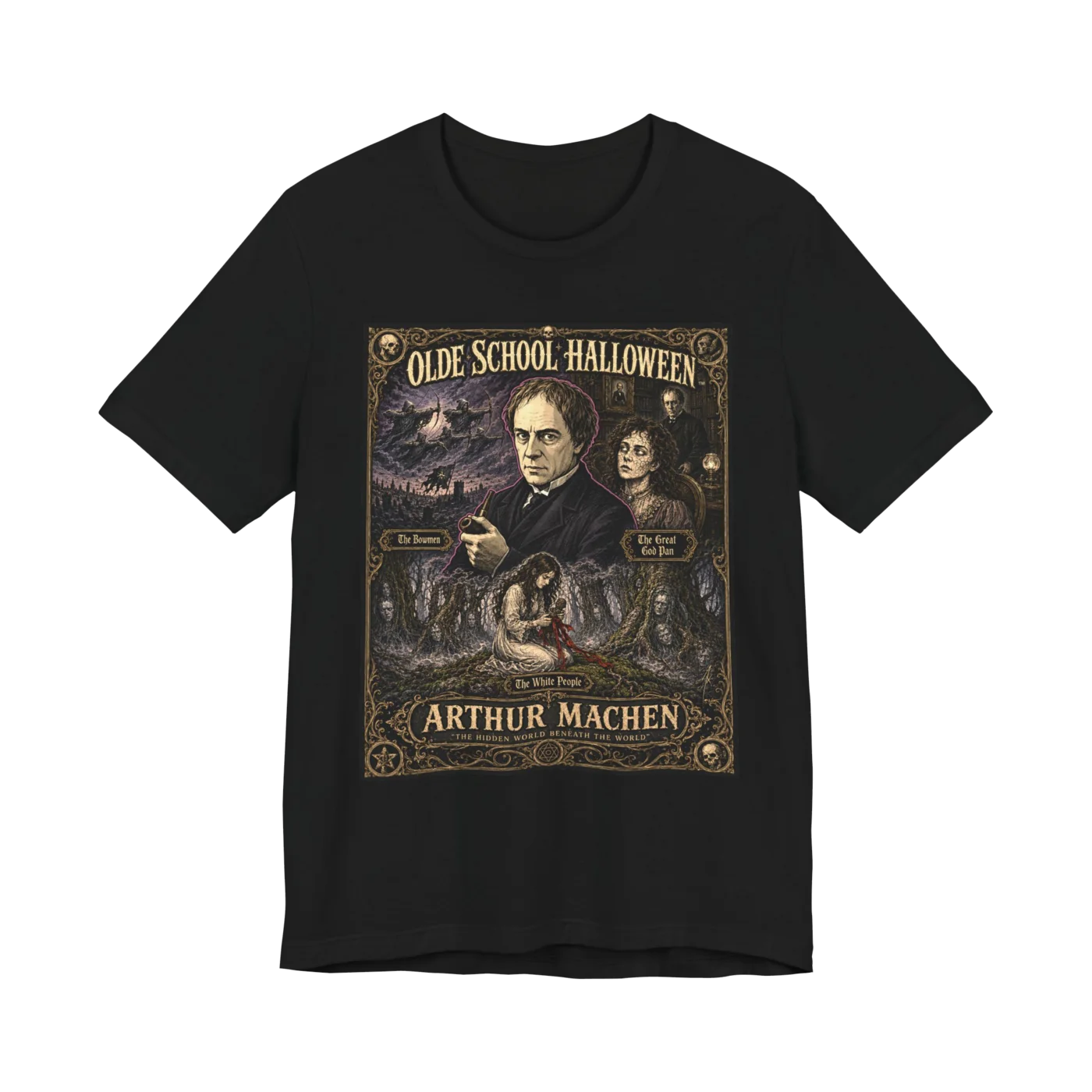
Shirts from this one
Four worlds, eight years, one shed.


The Porchlight
New shirts. Olde stories. First word on every sale.
Twice a month, thereabouts. Unsubscribe whenever.