
The Morgue / The Man Who Invented The Angels
The Man Who Invented The Angels
Arthur Machen wrote a short story for a London evening paper in 1914. Within a year the country believed it had happened, and he spent the rest of his life failing to convince anyone otherwise.
The ground he came from
Arthur Llewelyn Jones was born in 1863 at Caerleon, in Monmouthshire, which is a small place on the river Usk with an unusual amount underneath it. The Romans put a legionary fortress there — Isca — and the amphitheatre is still in the ground, and for centuries the locals called that oval depression King Arthur's Round Table because nobody had told them otherwise and it looked about right.
He was a clergyman's son. He grew up walking the Black Mountains and the old forest of Wentwood and the Severn valley, in country where a hill fort and a holy well and a Roman road are all the same walk, and he never really wrote about anything else for the next sixty years.
The thesis, stated as plainly as he ever stated it: the world we agree on is a lid. It is thin. Things are under it.
What that looked like on the page
In 1894 he published The Great God Pan, and the late-Victorian critics lost their composure entirely. The Westminster Gazette called it the most deliberately disagreeable book yet produced in English, which is the kind of review a writer has framed. What it actually is: a doctor operates on a young woman's brain to let her perceive the thing the ancients called Pan, and she survives the surgery in the sense that her body does, and twenty years later a woman of enormous beauty is moving through London society and the men who become involved with her keep dying by their own hands, and the ending — when somebody finally watches her die — is a paragraph of matter going backward through every form life has taken on the way up. Stephen King has called it possibly the best horror story in the English language. It got Machen described as a degenerate for a decade.
Ten years later came The White People, which is the one the connoisseurs give the crown to, and it works by a method nobody had used before. Most of it is a girl's private notebook. She is perhaps sixteen. Her nurse taught her games and songs and rhymes when she was small, and the names of things, and where to go in the woods and what to do when you get there — and she writes it all down in a cheerful, chatty, slightly breathless hand, because to her it is simply what one does. She has no idea she is describing anything unusual. The horror is entirely in the gap between what she is telling you and what you are working out.
There is a frame around it, two men in a room arguing about whether real evil is a matter of doing harm or of taking part in something, and then one of them hands the other the notebook. Machen's answer, essentially: sin is not cruelty. Sin is the rose singing, the stone speaking — a thing stepping outside the order it was given. That is a theological position and he meant it as one.
Then the war
By 1914 he had been a journalist on the Evening News for years, and had also been a founding-era member of the Hermetic Order of the Golden Dawn, translated Casanova's memoirs, catalogued occult books for a London dealer, and spent a great deal of his life poor.
In late August the news came back from Belgium. The British Expeditionary Force had met the German advance at Mons on the twenty-third and had been retreating ever since, badly outnumbered, in appalling heat, for two weeks. The papers were full of it. Machen read the accounts and, by his own description, sat in church that Sunday half-listening to the Gospel and making up a story in his head about the British Army standing in a furnace, consumed and shining at once.
On 29 September 1914 the Evening News printed "The Bowmen."
It is about two thousand words. A British soldier in the retreat, a man with a little Latin, remembers a motto he once saw on a plate in a vegetarian restaurant — Adsit Anglis Sanctus Georgius, may St George be a present help to the English — and he says it aloud while firing, half out of his mind. And the bowmen of Agincourt come. Five centuries dead, in a long line, shooting. The Germans fall in their thousands with no wound on any of them, and the line holds.
Machen wrote it in the first person, as a man's account of what he saw. He did not label it fiction. The Evening News ran fiction regularly, and in that same edition another piece was headed "Our Short Story," and "The Bowmen" was not.
The thing gets loose
Within days the letters started: what were his sources.
He answered them honestly, every time, from the beginning. There were no sources. He had made it up at a desk. He said so to readers, and he said so to the editors of Light and the Occult Review when they wrote to ask in September 1914, before the legend had properly formed.
It made no difference at all.
Parish magazines asked to reprint it and he let them, and in 1914 the parish magazine was a serious circulation — read across the country, trusted absolutely, and not in the business of running made-up war stories. The pieces went out into hundreds of parishes without the Evening News frame around them, and some of them without a byline.
Then a priest wrote to Machen. His magazine had sold out. He wanted to reprint "The Bowmen" as a pamphlet, and would Mr Machen be so good as to supply a short preface giving his sources.
Machen wrote back that they were most welcome to the pamphlet but there were no sources, because he had invented the whole thing.
The priest wrote back to tell Machen he was mistaken. The facts of the story were true. Machen had merely added some literary flourishes to an actual event.
That is the moment the thing stopped belonging to him.
Bowmen into angels
The transformation took a few months and nobody supervised it.
Machen's bowmen were medieval English archers — grubby, historical, and armed. That is not what a nation in its first winter of mass casualty wanted. By early 1915 the retellings had replaced them with shining figures, and shining figures who intervene from heaven are angels, which is a word with fifteen hundred years of authority behind it. Machen himself noted the mechanism afterward with what reads like weary precision: in the popular view, benevolent supernatural beings are angels, and so his bowmen had become the Angels of Mons.
And then the testimony arrived. In May 1915 the Occult Review reported that those who could see had seen a row of shining beings standing between the two armies. A letter from a Miss Marrable appeared in the All Saints, Clifton parish magazine, reprinted in the Church Family Newspaper in July, relating what two officers had told her. A woman writing as Phil Campbell published an account in the Occult Review claiming to have nursed men at the front who had seen them. In September 1915 the Evening News — Machen's own paper — printed a letter from a lieutenant-colonel describing ghostly horsemen riding alongside the retreat.
None of it traces back to anything before 29 September 1914.
And the War Office never issued a denial, because why would the War Office spend a morning denying angels in the winter of 1915. The absence of an official contradiction was read, widely and reasonably, as confirmation.
Why it was needed
None of this explains why a country believed it. Parish magazines and an absent denial explain how the story travelled. They do not explain the appetite.
The appetite was this. The First World War killed on an industrial scale, and it also did something to the dead that no previous war had done at that volume: it removed a great many of them entirely.
High-explosive shellfire does not leave a body every time. And the ground on the Western Front was shelled, and shelled again, and shelled again over the same few square miles for four years, so that men buried by one barrage were turned up and scattered by the next, and the mud took what was left. The word the records use is missing, which sounds administrative and is not. It means there was nothing to send home. Nothing to identify. Nothing to bury.
Take the Commonwealth figures, because they are counted and public. Around a million Commonwealth servicemen died in that war. More than half a million of them have no known grave. Not lost paperwork — no grave.
That is why the memorials to the missing exist, and why they are the size they are. Thiepval, on the Somme, carries over seventy-two thousand names of men who died within a few miles of it and were never found. The Menin Gate at Ypres carries nearly fifty-five thousand — and the architects ran out of wall, so thirty-four thousand more names had to go up at Tyne Cot instead. Around a hundred and twenty such memorials were built. Where a body was recovered but could not be named, the headstone reads Known Unto God, and Kipling — who lost his own son at Loos in 1915 and never found him either — helped choose the wording.
Now hold that against the autumn of 1914 and the years after it. Hundreds of thousands of British households received a telegram and then nothing else, ever. No coffin, no funeral, no churchyard, no place to stand on a Sunday. In a culture that organised its entire relationship with death around the burial service and the marked grave, the machinery for grieving had simply been withdrawn.
And into that, in the third month of the war, comes a story printed in a London paper saying that at the very worst hour of the retreat — outnumbered, exhausted, being killed in the open — those men were not alone. That the sky opened over them. That five centuries of English dead came back and stood in the line beside them.
Of course it was believed. It was the only thing on offer that made the absence bearable, and it arrived, unlabelled, in a newspaper, at exactly the moment there was nothing else.
Machen understood this perfectly well, which is part of why he could never bring himself to be angry about it. He had written the story to give people something to hold. They held it much harder than he intended, and then they would not put it down, and he could hardly blame them for that.
Thirty years of explaining
He published The Bowmen and Other Legends of the War in 1915 with an introduction laying the whole business out — what he wrote, when, why, and out of what. It sold extremely well. It changed nothing.
He went on correcting the record for the rest of his life, and the correction kept being absorbed as further evidence: the poor man was being modest, or had been got at, or had received the vision himself and was too humble to claim it. There is no available move in that position. A denial from the author is exactly what the story predicts an author would say.
He died in 1947, eighty-four years old, having watched a piece of his own fiction outgrow him by a factor he could not measure. The Angels of Mons are now generally reckoned the first mass-media legend of the twentieth century — the first time a printed fiction detached from its page, changed shape in transmission, acquired eyewitnesses, and became something a whole country simply knew.
Every rumour that has ever moved faster than its correction is running the same machinery. He built the prototype in two thousand words on a Tuesday, to cheer people up.
The mechanism did not retire with him. Sixty years later, American parents X-rayed their children's Halloween candy for razor blades that no one has ever found in it.
The joke at the bottom of it
Here is what makes the whole affair one of the finest ironies in English letters.
Machen's entire body of work argues one thing: the world we agree on is a thin lid, and there are older powers underneath it, and they can come through.
He spent his career trying to make readers feel the reality of that. Reviewers called him decadent. Sales were poor. The Hill of Dreams, which is probably his masterpiece, sat unpublished for years because nobody wanted it.
And then he wrote two thousand words of frank invention for an evening paper, and the lid came off — not in Monmouthshire, not in a Roman amphitheatre, but in the middle of industrial Britain, in the parish magazines and the letters columns, exactly as he had always said it could.
He got the hidden world he wanted. It came through his own newspaper column. And it would not go back under.
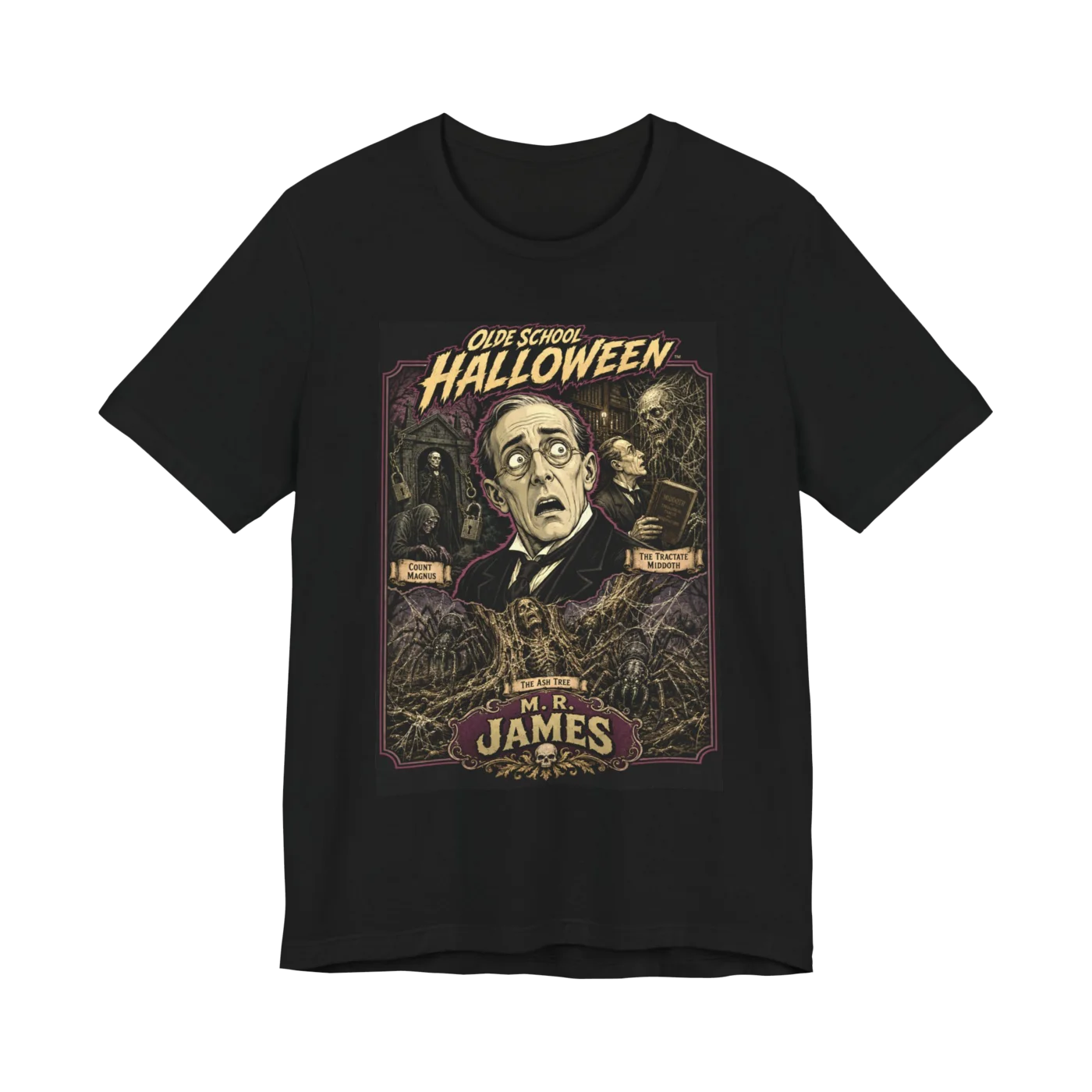
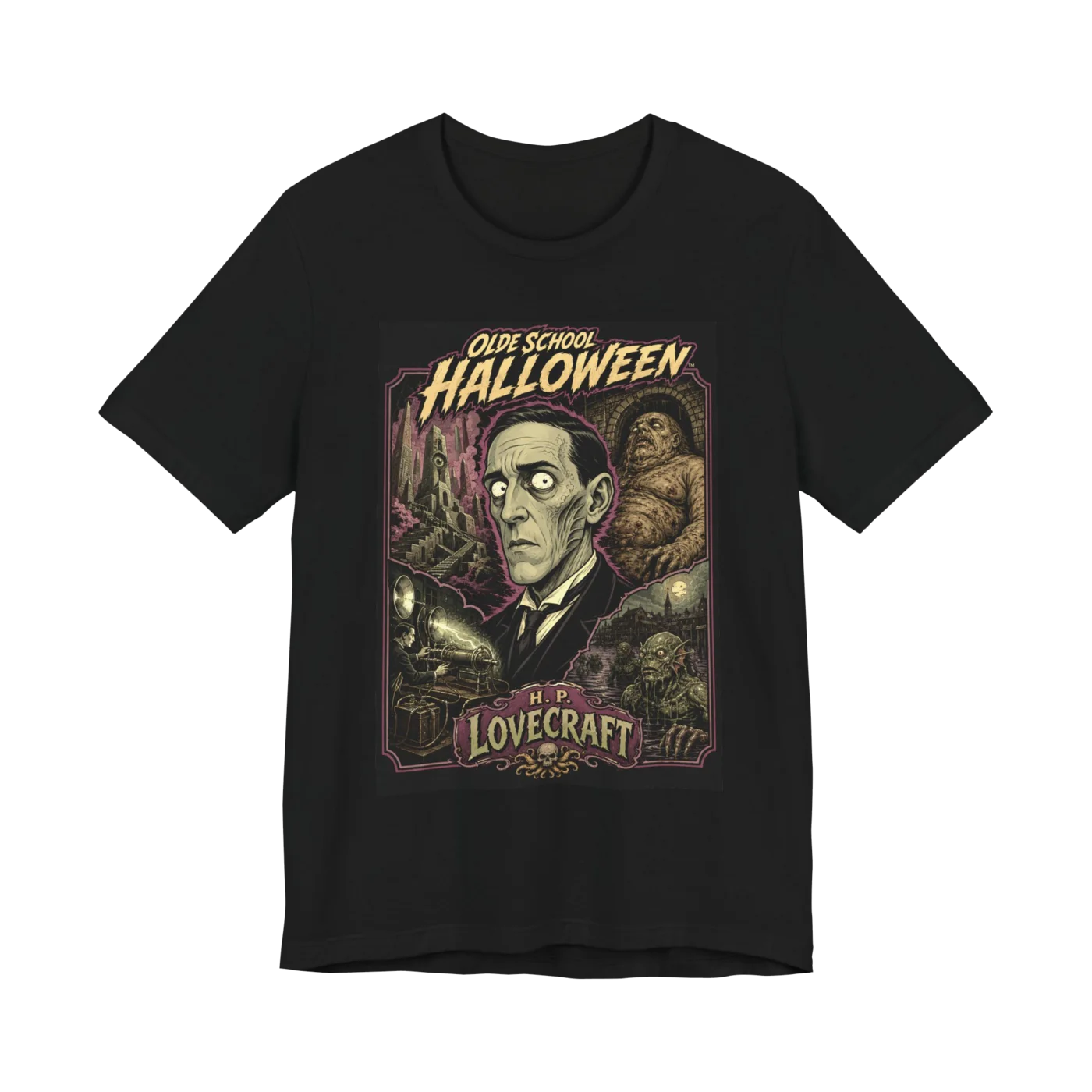
Shirts from this one
The thin lid, and what came through it.



The Porchlight
New shirts. Olde stories. First word on every sale.
Twice a month, thereabouts. Unsubscribe whenever.